
Does Jesus Say I am Lucifer in Revelation 22:16?
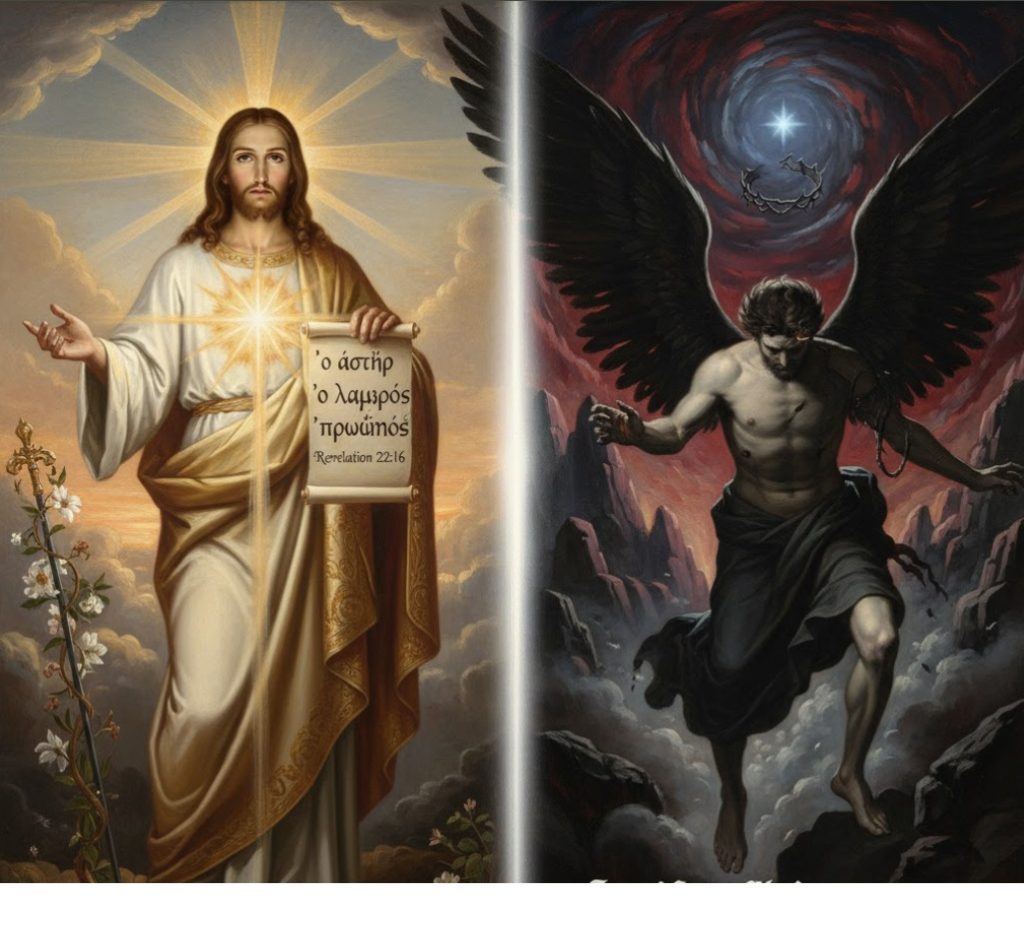
Does Jesus Say I am Lucifer in Revelation 22:16?
Many readers of the Bible, and some non-believers, have encountered the deeply unsettling claim that the Book of Revelation contains a shocking admission: that Jesus Christ actually identifies himself as Lucifer in chapter 22, verse 16. This startling assertion often surfaces in online discussions, purporting to expose a hidden truth within Christian scripture.
The verse in question reads, “I, Jesus, have sent my angel to give you this testimony for the churches. I am the Root and the Offspring of David, and the bright Morning Star.” But does this title, the “bright Morning Star,” truly equate to the figure of Lucifer, the fallen angel?
Our fact-check dives into the original language, biblical context, and theological understanding of Revelation 22:16 to definitively answer whether Jesus is claiming to be Lucifer or not.
The Meaning of “Morning Star”
The crucial phrase is ’o asteË‹r ’o lamproË‹s ’o proˉı¨noËŠs (the bright, the morning star) in the original Greek. This title is a self-designation of Christ’s glory and absolute preeminence.
- Christ’s Divine Glory: In the biblical cosmos, the rising morning star (often identified with the planet Venus) is the most prominent and radiant celestial body just before sunrise. By claiming this title, Jesus is asserting that he is the source of all light, the herald of the new day, and the most glorious figure in creation, foreshadowing his return (parousia). He is the true light (John 1:9) that ends the spiritual night.
- A Prophetic Fulfillment: This title is a clear link to the Old Testament prophecy in Numbers 24:17, which speaks of a Messiah: “A Star will come out of Jacob; a Scepter will rise out of Israel.” Jesus is claiming the fulfillment of this ancient Messianic prophecy.
- Contrast to Lucifer: The claim that Jesus is Lucifer stems from a misreading of Isaiah 14:12, where the King of Babylon is sarcastically addressed as heˆleˉl ben-sˇaˉḥar (day star, son of the morning). The Latin Vulgate translated heˆleˉl as “Lucifer” (meaning “light-bearer” or “morning star” in Latin). However, the context of Isaiah 14 is a taunt against an arrogant earthly king, not a reference to Satan’s original name. The New Testament uses a different Greek word and context in Revelation 22:16 to refer to Christ, signifying his ultimate victory and divinity, in stark contrast to the pride and fall of the Babylonian king/Satanic figure mentioned in Isaiah.
Context within Revelation
The verse is one of three powerful claims Jesus makes about himself in this final passage of Revelation:
- “The Root and the Offspring of David”: This confirms his humanity (being a descendant/offspring) and his divinity (being the root/source of David’s line, predating him). It proves his right to the Messianic throne.
- “The bright Morning Star”: This confirms his divine glory and his triumphant return.
Far from claiming to be the devil, Revelation 22:16 functions as a final, glorious summary of Christ’s identity, asserting both his lineage as the promised Messiah and his divine nature as the eternal Light.
Comments
Related Posts

Former Christian Woman, Brooklyn, Shares Emotional Account of Converting to Islam In a deeply moving video that has captured attention across social media platforms, a woman identified as Brooklyn bravely shared her journey of faith, tearfully recounting her decision to transition from Christianity to Islam. The viral recording offers a...

Traditional jewish Dance: Ass Drumming They drum each others hips in a very difficult position. One of the partners wraps their legs around the other’s waist and holds on overhead while they “play the darbuka” with their buttocks. We call this dance “ass drumming or hip drumming”. Lets watch this...

Does The Prophet Mohammad Have Jewish Pagan Ancestors? In recent times, a fascinating and controversial discussion has gained traction within certain historical and online circles: the claim that the family of the Prophet Muhammad may have had Jewish roots. This idea challenges long-held traditional narratives and opens a complex dialogue...

Sanhedrin 69b: Batsheva gave birth when aged six A passage from Sanhedrin 69b: “The Gemara refutes this proof: From where do you prove this? Perhaps both Ahithophel and his son Eliam fathered children when they were each nine years old, and Bathsheba gave birth to Solomon when she was six,...

Quran 37:12 Khalaf and Hafs Version Difference The difference between the Hafs and Khalaf versions of Quran 37:12 (Surah As-Saffat) lies in a single vowel on the verb عجبت (‘ajibta / ‘ajibtu), which changes the subject of the sentence (who is doing the “wondering”). Here is the breakdown of the...

What Quran says about inter religion marriage ? Inter religion marriage in Quran is one of the most popular subject given the fact that people meet eachother online and make marriage decision. What Quran Says About Inter Religion Marriages ? In the Quran, there is no specific mention about inter-religion...